Tiffany Shlain
Field: arts
Tiffany Shlain reflects on her own 1992 graduation from UC Berkeley during a difficult economic period and traces her career founding the Webby Awards and making films, emphasizing boldness ('moxie') and learning from failure. She recounts the personal experience of her father's death and her daughter's birth occurring in the same week, which reshaped her view of connection and presence. She encourages graduates to see the internet-connected world as an opportunity to make change and to look for connections rather than only breaking problems down.
Key moments
- 01 Recalling graduating in 1992 amid recession and choosing work she loved
- 02 The importance of 'moxie' illustrated by her Alcatraz film phone call and creating the Webby Awards
- 03 Failing on her unfinished feature film and learning from that setback
- 04 Her father's death and daughter's birth in the same week reshaping her sense of connection
- 05 Urging graduates to seek connections and make small changes with ripple effects
Save the visual map
Download or open the generated poster as a standalone PNG.
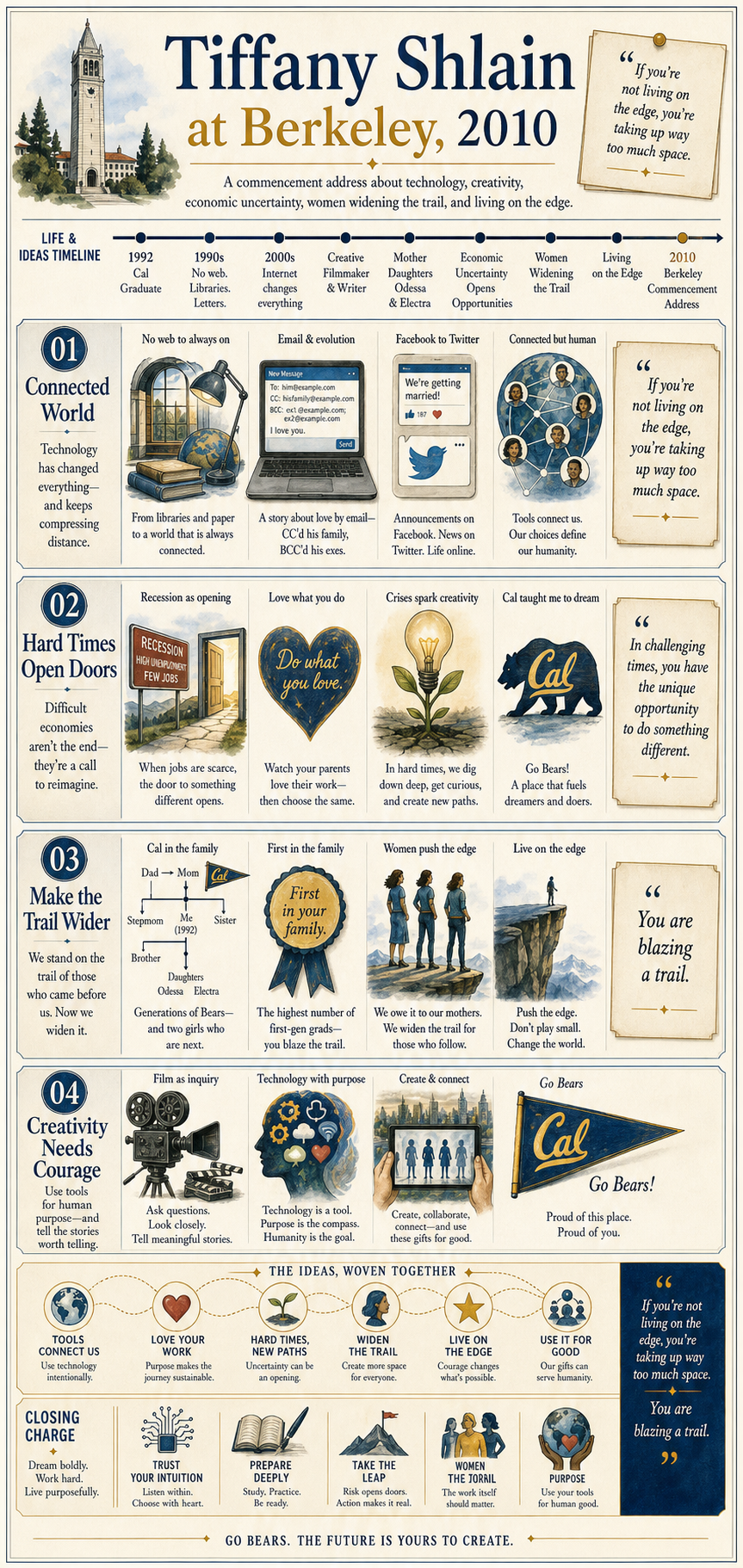
Tiffany Shlain at Berkeley, 2010
A University of California, Berkeley address about technology, creativity, economic uncertainty, women widening the trail, and living on the edge.
Speech arc
- 01UC Berkeley
Opening move
- 02Class of 2010
Speech beat
- 03Cal family roots
Speech beat
- 04Internet age
Speech beat
- 05Recession as opening
Speech beat
- 06Love what you do
Speech beat
- 07Women widen the trail
Speech beat
- 08Creative courage
Final charge
Technology: The connected world changed the scale of everything
Shlain opens by contrasting her pre-web Berkeley years with a world of email, Facebook, Twitter, and instant connection, using humor to make the shift concrete.
Then
The class inherits tools that did not exist when she sat at commencement.
Speed
Digital communication can accelerate intimacy, announcements, and mistakes.
Purpose
The speech treats technology as powerful only when connected to human intent.
Shlain opens by contrasting her pre-web Berkeley years with a world of email, Facebook, Twitter, and instant connection, using humor to make the shift concrete.
Opportunity: A hard economy can clear room for honest choices
Facing a poor job market, graduates are invited to ask what they actually want to build instead of being pulled too quickly toward a safe track.
Recession
She connects 1992 uncertainty with the class's own difficult economy.
Question
The pressure becomes a chance to ask what work is worth doing.
Model
Her parents' love for their work becomes the standard she carries forward.
Facing a poor job market, graduates are invited to ask what they actually want to build instead of being pulled too quickly toward a safe track.
Trail: Graduates inherit trails and must make them wider
Shlain honors first-generation graduates and women whose mothers and grandmothers opened paths, then turns that inheritance into a charge to widen access.
Firsts
The address pauses on the achievement of being first in a family to graduate.
Women
Progress is framed as a trail made by earlier generations that still needs widening.
Edge
Her father's advice makes risk and growth part of the graduates' work.
Shlain honors first-generation graduates and women whose mothers and grandmothers opened paths, then turns that inheritance into a charge to widen access.
• Key takeaways •
Technology changes speed, not values
Connects to technology.
Hard times can reveal real priorities
Connects to creativity.
Inherited trails need to be widened
Connects to economic uncertainty.
Creativity requires edge and courage
Connects to women.
Purpose gives connection meaning
Connects to purpose.
Closing charge
The speech ties filmmaking, technology, family, and Berkeley identity into a practical ethic: use the tools of the age to ask better questions and make useful things.
Creative work begins where curiosity meets courage
Film
Her creative path starts with asking questions and turning them into work.
Courage
Living on the edge means making choices before certainty arrives.
Charge
Graduates are asked to connect their talents to a larger human purpose.
The speech ties filmmaking, technology, family, and Berkeley identity into a practical ethic: use the tools of the age to ask better questions and make useful things.
Visual speech maps
Browse more visual maps from University of California, Berkeley or continue with related mapped speeches below.
Transcript
The previously catalogued transcript link is no longer live and is queued for re-sourcing. A video of the address is available above.
Machine transcript available for archive analysis; it is unverified and may contain transcription errors. Machine transcript source ->
Provenance
BROKEN transcript link (checked 2026-06-26): gradspeeches.com is a parked/redirecting domain serving no real content. Provenance: Imported from NPR commencement archive; cross-referenced with Open Commencement DB
NPR archive last updated in 2015; destination availability has not been exhaustively rechecked | Open Commencement DB transcript; not independently verified against the original recording | Transcript URL dead (gradspeeches.com is a parked/redirecting domain serving no real content); video fallback present
Explore this speech
Find the next thread through the archive
Themes in this address
Speeches like this one
Search all speeches ->