Robert Krulwich
Field: arts
Robert Krulwich addresses Berkeley Journalism School's Class of 2011 amid a difficult job market and a changing media industry. He argues that the era of secure, protective jobs at large media institutions—exemplified by Charles Kuralt's CBS career—has vanished, and that graduates cannot rely on companies to keep them safe. He encourages young journalists not to wait to be hired but to act on their own hunger and initiative, illustrating with stories from his own early, self-started forays into journalism.
Key moments
- 01 Acknowledging the tough job market and likening established media to a walled fortress
- 02 The story of Charles Kuralt's rise at CBS when journalism felt like a calling that protected its own
- 03 The realization that companies no longer offer loyalty or job security
- 04 Urging graduates to be people who 'don't wait' and create their own opportunities
- 05 Krulwich's anecdotes of forging press credentials and recording an impeachment series at home
Save the visual map
Download or open the generated poster as a standalone PNG.
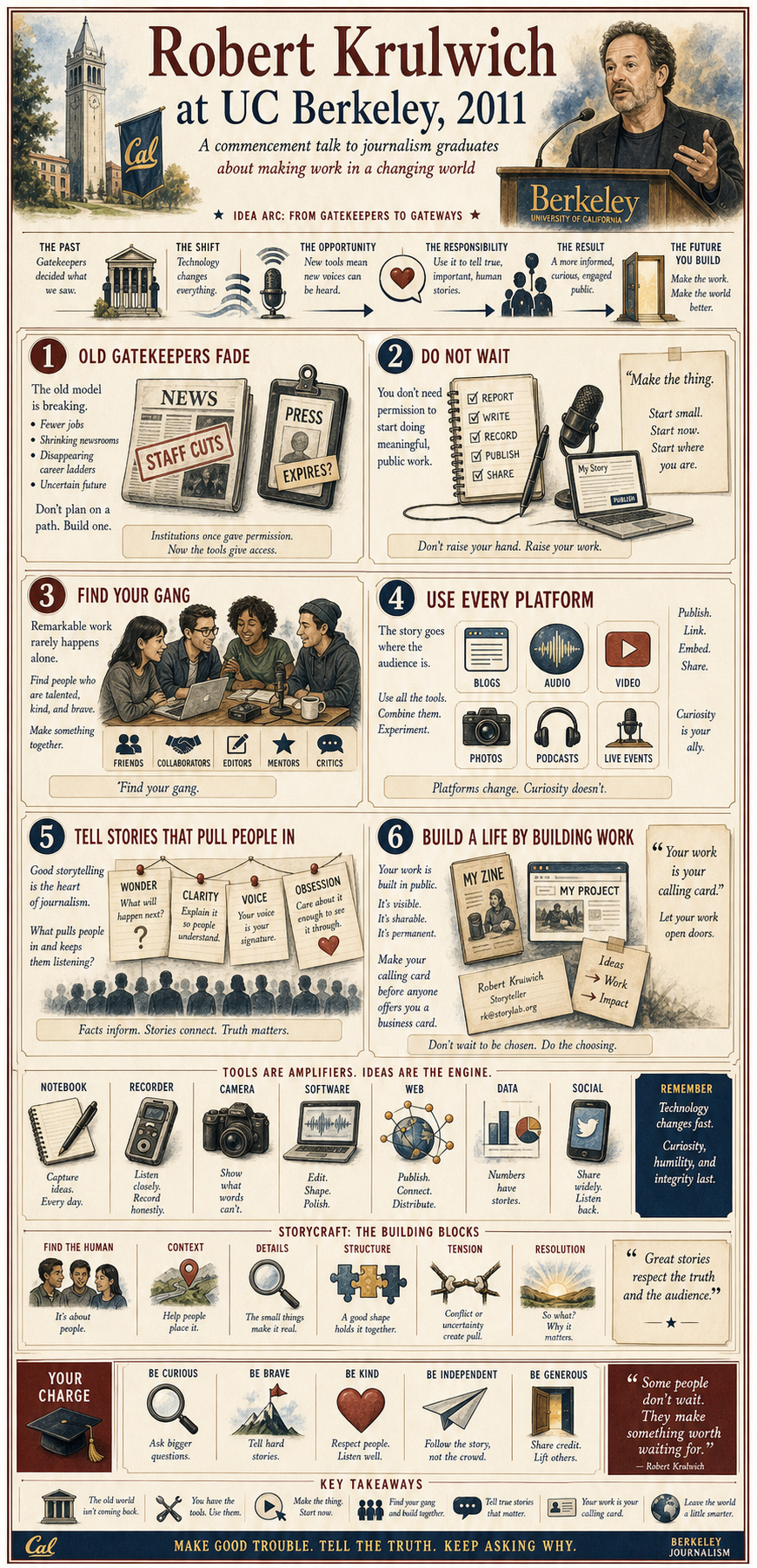
Robert Krulwich at UC Berkeley, 2011
A journalism commencement address about not waiting for permission, finding collaborators, using new tools, and making work before institutions ask.
Speech arc
- 01UC Berkeley
Opening move
- 02Journalism shift
Speech beat
- 03Gatekeepers fade
Speech beat
- 04Do not wait
Speech beat
- 05Find your gang
Speech beat
- 06Use platforms
Speech beat
- 07Tell irresistible stories
Speech beat
- 08Work as calling card
Final charge
Industry: Old gatekeepers are fading
Krulwich speaks to journalism graduates as traditional routes weaken and institutions no longer define all opportunity.
Shift
The old job ladder is unstable.
Risk
Waiting for permission can become its own trap.
Opening
New tools let makers reach audiences directly.
Krulwich speaks to journalism graduates as traditional routes weaken and institutions no longer define all opportunity.
Initiative: Some people do not wait
The core charge is to start reporting, writing, recording, editing, and publishing before anyone grants official authority.
Practice
Make the thing and let the work become proof.
Tempo
Momentum belongs to people who begin.
Proof
A public body of work can become a calling card.
The core charge is to start reporting, writing, recording, editing, and publishing before anyone grants official authority.
People: Find your gang
Independent work still needs collaborators: peers, friends, editors, producers, designers, and curious co-conspirators.
Crew
A small circle can make ambitious work possible.
Voice
Different talents sharpen story and craft.
Durability
Community keeps the work going when institutions lag.
Independent work still needs collaborators: peers, friends, editors, producers, designers, and curious co-conspirators.
• Key takeaways •
Do not wait for permission
Connects to journalism.
Make work in public
Connects to creativity.
Find collaborators
Connects to initiative.
Use every platform
Connects to collaboration.
Story craft still matters
Connects to work.
Closing charge
The final map joins platforms with craft: curiosity, clarity, voice, and obsession are what make journalism travel.
Tell stories that pull people in
Tools
Blogs, audio, video, web experiments, and public curiosity are all available.
Wonder
The work should make people want to keep listening or reading.
Charge
Build a life by building the work.
The final map joins platforms with craft: curiosity, clarity, voice, and obsession are what make journalism travel.
Visual speech maps
Browse more visual maps from University of California, Berkeley or continue with related mapped speeches below.
Transcript
The full transcript is hosted by the original publisher. Commencement Archive links to the source rather than republishing copyrighted text.
Read the full transcript at source →Provenance
Imported from NPR commencement archive; cross-referenced with Open Commencement DB
NPR archive last updated in 2015; destination availability has not been exhaustively rechecked | Open Commencement DB transcript; not independently verified against the original recording
Explore this speech
Find the next thread through the archive
Themes in this address
Speeches like this one
Search all speeches ->