George Saunders
Field: letters
George Saunders tells graduates that his deepest regret is his failures of kindness, illustrating this with the memory of a shy classmate he never bullied but also never truly helped. He argues that selfishness stems from built-in human confusions and that, while ambition and success have their place, the central goal of life should be becoming kinder and more loving. He urges graduates to accelerate that process rather than wait for it to come naturally with age.
“Err in the direction of kindness.”
Key moments
- 01 Recalling regret over not being kinder to a shy classmate named Ellen
- 02 Identifying built-in human confusions that drive selfishness
- 03 Warning that the pursuit of success can crowd out the big questions
- 04 Advising graduates to err in the direction of kindness and start now
Save the visual map
Download or open the generated poster as a standalone PNG.
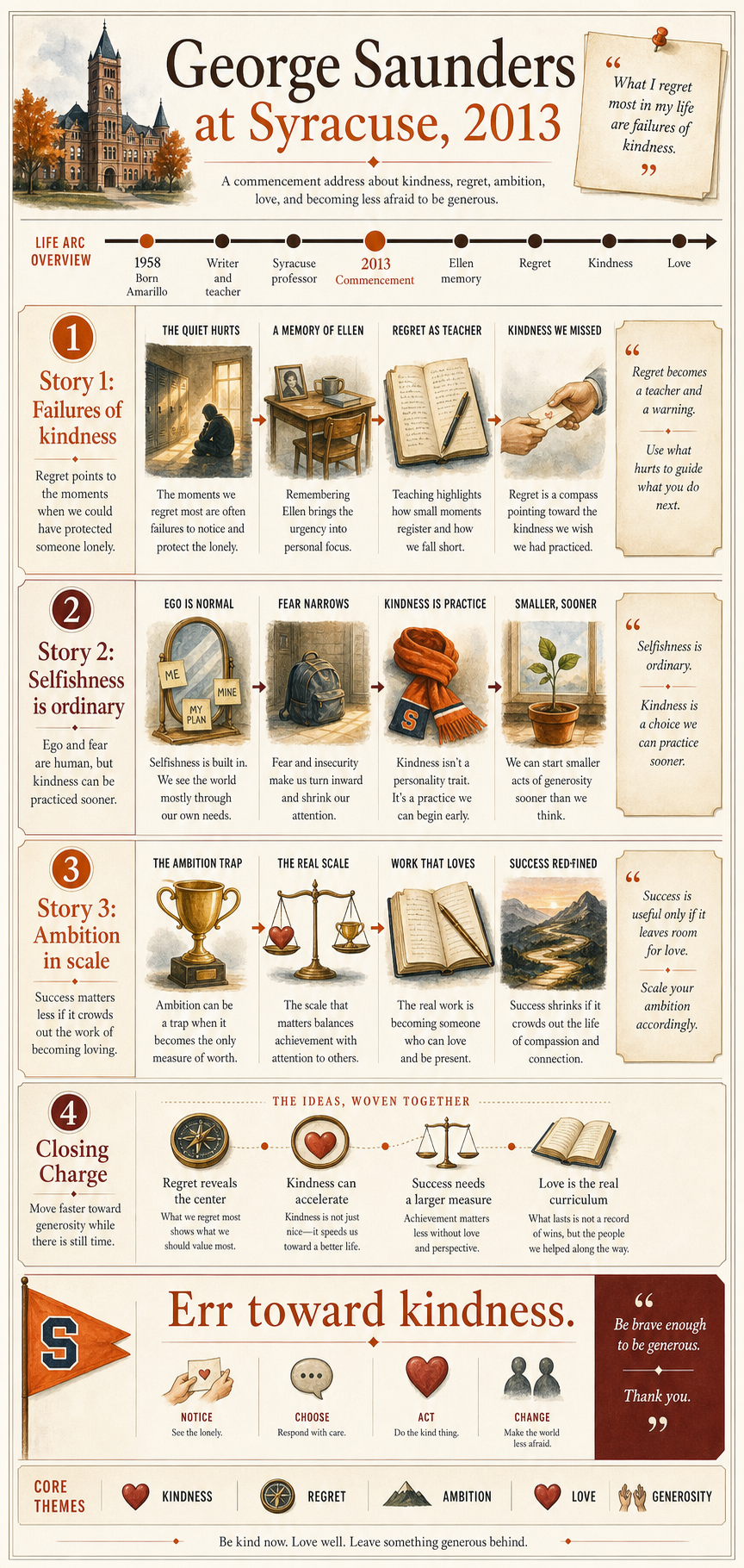
George Saunders at Syracuse, 2013
A Syracuse commencement address about kindness, regret, selfishness, ambition, love, and the urgency of becoming less afraid to be generous.
Speech arc
- 01Writer returns
Opening move
- 02Regret as teacher
Speech beat
- 03Ellen memory
Speech beat
- 04Failures of kindness
Speech beat
- 05Built-in selfishness
Speech beat
- 06Success has limits
Speech beat
- 07Love accelerates
Speech beat
- 08Err toward kindness
Final charge
Regret: The speech begins with what still hurts
Saunders rejects trophy-case advice and starts from a quieter moral memory: the moments he regrets most are failures to be actively kind.
Source
The repository links to the archived New York Times publication of the speech, and the enrichment record is grounded in that full text.
Memory
The classmate story gives the speech a precise emotional center: not cruelty alone, but the missed chance to protect someone lonely.
Measure
Regret becomes a diagnostic tool for what actually mattered after ambition, cleverness, and status faded.
Saunders rejects trophy-case advice and starts from a quieter moral memory: the moments he regrets most are failures to be actively kind.
Human nature: Selfishness is ordinary but not final
The address treats selfishness as a built-in human confusion rather than a monstrous exception, which makes kindness a practice instead of a personality trait.
Honesty
Saunders gives graduates a realistic account of ego, fear, and self-protection without letting those forces become excuses.
Practice
Kindness is something people can choose more often, more quickly, and with less embarrassment.
Growth
Aging may soften people, but the speech asks graduates not to wait decades for moral clarity.
The address treats selfishness as a built-in human confusion rather than a monstrous exception, which makes kindness a practice instead of a personality trait.
Ambition: Success is useful but too small to worship
Saunders does not mock ambition; he puts it in scale. Careers, talent, and accomplishment matter less if they crowd out the work of becoming loving.
Warning
The pursuit of success can feel urgent enough to postpone the big questions until the habit of postponement becomes a life.
Balance
The speech keeps professional striving but refuses to let it become the highest moral category.
Center
The real graduation task is interior: become less selfish, less afraid, and more available to other people.
Saunders does not mock ambition; he puts it in scale.
Careers, talent, and accomplishment matter less if they crowd out the work of becoming loving.
• Key takeaways •
Regret reveals the moral center
Connects to kindness.
Kindness can be accelerated
Connects to regret.
Selfishness is ordinary but movable
Connects to selfishness.
Success needs a larger measure
Connects to success.
Love is the real curriculum
Connects to love.
Closing charge
The closing charge is simple and demanding: move faster toward kindness than life would move you on its own, and err in that direction while there is still time.
Accelerate toward love now
Urgency
Do not treat generosity as a retirement project.
Direction
When unsure, choose the response that enlarges mercy.
Afterlife
The speech endures because its advice is small enough for daily use and large enough to judge a life.
The closing charge is simple and demanding: move faster toward kindness than life would move you on its own, and err in that direction while there is still time.
Visual speech maps
Browse more visual maps from Syracuse University or continue with related mapped speeches below.
Transcript
The full transcript is hosted by the original publisher. Commencement Archive links to the source rather than republishing copyrighted text.
Read the full transcript at source →Provenance
Imported from NPR commencement archive; cross-referenced with Open Commencement DB
NPR archive last updated in 2015; destination availability has not been exhaustively rechecked | Open Commencement DB transcript; not independently verified against the original recording
Explore this speech
Find the next thread through the archive
Themes in this address
Speeches like this one
Search all speeches ->