Makoto Fujimura
Field: arts
Artist Makoto Fujimura reflects on his visit to tsunami- and nuclear-disaster-stricken Japan, weaving the devastation together with meditations on beauty, grief, and hope. He argues that art is a cultural necessity that awakens the senses to what he calls 'the aroma of the new,' pointing toward a greater reality and 'the world that ought to be.' He urges graduates to create out of sacrificial love amid the uncertainties of what sociologist Zygmunt Bauman terms 'liquid modernity.'
Key moments
- 01 Recounting the devastation in Ishinomaki, Japan, including a 17-year-old survivor showering for the first time in a month
- 02 Quoting T.S. Eliot's 'The Waste Land' on April as the cruelest month to link beauty and grief
- 03 Describing the smell of bacon and eggs in a production of 'Our Town' as evidence of a reality behind reality
- 04 Calling graduates to create out of love upon their 'ground zero' conditions
Save the visual map
Download or open the generated poster as a standalone PNG.
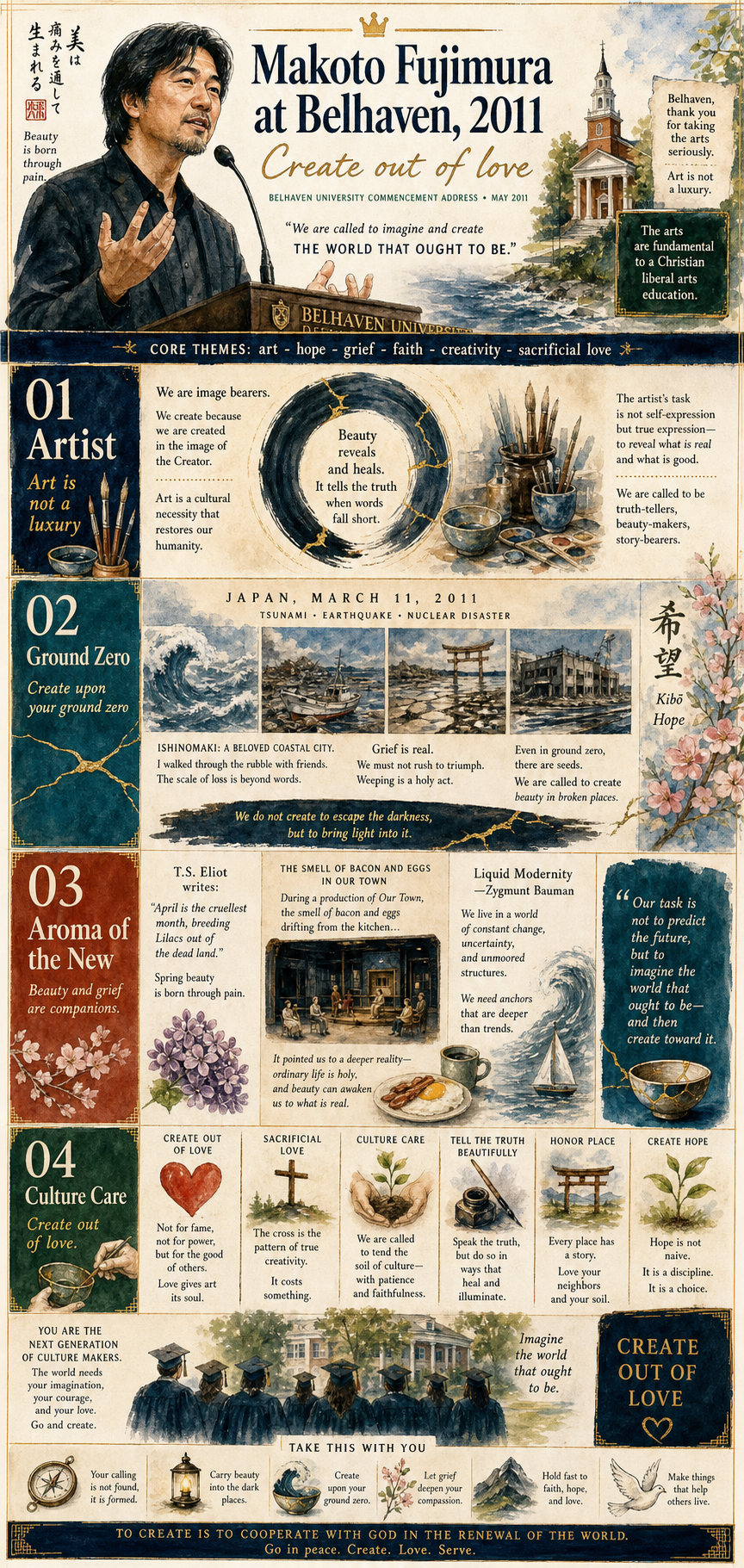
Makoto Fujimura at Belhaven, 2011
A Belhaven address about art as cultural necessity, beauty inside grief, post-disaster Japan, culture care, and creating out of sacrificial love.
Speech arc
- 01Belhaven commencement
Opening move
- 02Machine transcript
Speech beat
- 03Arts as fundamental
Speech beat
- 04Japan 2011
Speech beat
- 05Beauty and grief
Speech beat
- 06Aroma of the new
Speech beat
- 07Liquid modernity
Speech beat
- 08Create out of love
Final charge
Artist: The arts are named as central, not ornamental
Fujimura begins by thanking Belhaven for honoring an artist at a Christian institution and argues that art is a cultural necessity for restoring humanity.
Honor
The ceremony itself becomes a statement that art belongs at the center of higher education.
Necessity
Art is rejected as a peripheral luxury and reframed as a way civilization defines and restores itself.
Calling
Graduates are invited to become makers who tell truth and help others perceive what is real.
Fujimura begins by thanking Belhaven for honoring an artist at a Christian institution and argues that art is a cultural necessity for restoring humanity.
Ground Zero: Disaster makes the need for beauty more urgent
Reflecting on Japan after the 2011 tsunami and nuclear disaster, the speech refuses easy consolation while insisting that creation can begin in broken places.
Ishinomaki
The devastated coastal city anchors the speech in concrete grief rather than abstraction.
Witness
The transcript recalls encounters with survivors and the scale of loss after earthquake, tsunami, and nuclear crisis.
Seed
Even ground zero conditions can become a place where love, patience, and imagination begin again.
Reflecting on Japan after the 2011 tsunami and nuclear disaster, the speech refuses easy consolation while insisting that creation can begin in broken places.
Aroma: Beauty and grief are companions, not opposites
Fujimura links T.S. Eliot's April imagery, the sensory detail of bacon and eggs in Our Town, and Bauman's liquid modernity to show how art points beyond visible damage.
Eliot
Spring beauty is made complicated by grief, memory, and the pain of renewal.
Theater
The smell of breakfast in Our Town becomes evidence that ordinary life can awaken deeper reality.
Modernity
In liquid modernity, art gives people anchors deeper than trends and structures.
Fujimura links T.S.
Eliot's April imagery, the sensory detail of bacon and eggs in Our Town, and Bauman's liquid modernity to show how art points beyond visible damage.
• Key takeaways •
Art restores perception
Connects to art.
Beauty can pass through grief
Connects to hope.
Ground zero can become soil
Connects to grief.
Culture needs patient care
Connects to faith.
Create out of sacrificial love
Connects to creativity.
Closing charge
The closing movement asks graduates to create from love, tend culture patiently, and imagine a renewed world rather than merely predict the future.
Create toward the world that ought to be
Love
Creation is framed as sacrificial love for neighbors, places, and future communities.
Hope
Hope is not naive escape; it is a disciplined act of making in dark conditions.
Charge
Graduates are sent to create upon their own ground zero with courage, faith, and care.
The closing movement asks graduates to create from love, tend culture patiently, and imagine a renewed world rather than merely predict the future.
Visual speech maps
Browse more visual maps from Belhaven University or continue with related mapped speeches below.
Transcript
The previously catalogued transcript link is no longer live and is queued for re-sourcing. A video of the address is available above.
Machine transcript available for archive analysis; it is unverified and may contain transcription errors. Machine transcript source ->
Provenance
BROKEN transcript link (checked 2026-06-26): gradspeeches.com is a parked/redirecting domain serving no real content. Provenance: Imported from NPR commencement archive; cross-referenced with Open Commencement DB
NPR archive last updated in 2015; destination availability has not been exhaustively rechecked | Open Commencement DB transcript; not independently verified against the original recording | Transcript URL dead (gradspeeches.com is a parked/redirecting domain serving no real content); video fallback present
Explore this speech
Find the next thread through the archive
Themes in this address
Speeches like this one
Search all speeches ->