Tim Cook
CEO, Apple
Apple CEO Tim Cook urged MIT's Class of 2017 to seek purpose beyond themselves and to ask how they will serve humanity. Drawing on his own search for meaning and his work with Steve Jobs, he argued that technology must be paired with human values and the humanities to do great things, and that solving the world's hardest problems requires placing people at the center of one's work.
“When you work toward something greater than yourself, you find meaning, you find purpose.”
Key moments
- 01 Recounting his search for purpose and joining Apple under Steve Jobs
- 02 Posing the central question: how will you serve humanity?
- 03 Warning that technology alone is not the solution and can be part of the problem
- 04 Citing Pope Francis and calling for technology married with the humanities and human values
Save the visual map
Download or open the generated poster as a standalone PNG.
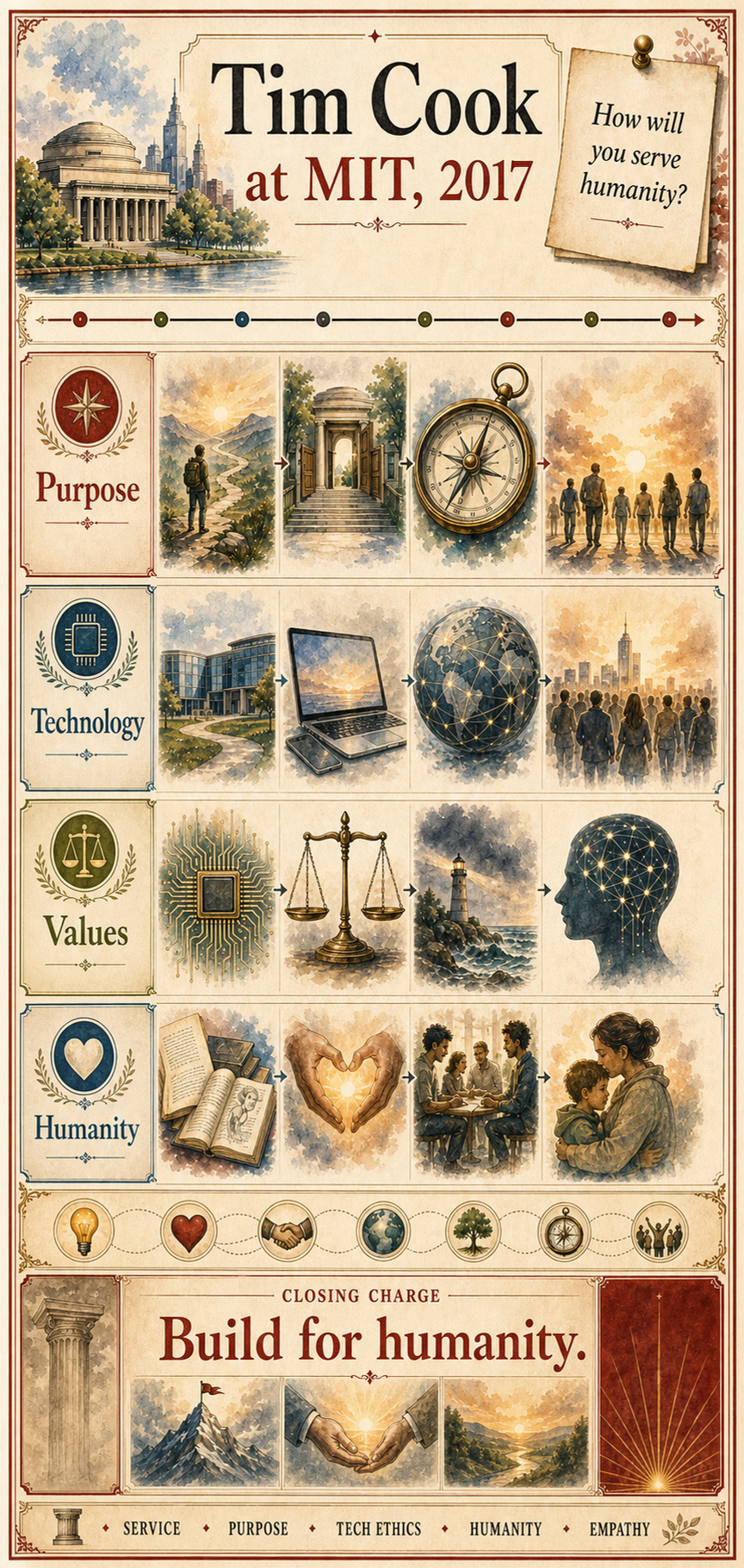
Tim Cook at MIT, 2017
A commencement address about purpose, service, technology with values, the humanities, empathy, and placing people at the center.
Speech arc
- 01Search for purpose
Opening move
- 02Apple
Speech beat
- 03Steve Jobs
Speech beat
- 04Serve humanity
Speech beat
- 05Technology limits
Speech beat
- 06Human values
Speech beat
- 07Empathy
Speech beat
- 08People first
Final charge
Purpose: Find work larger than yourself
Cook frames his own search for purpose as unfinished until technology became connected to service and human consequence.
Search
Professional success alone does not answer meaning.
Apple
Joining Apple becomes a turn toward mission.
Question
The test is how your work serves humanity.
Cook frames his own search for purpose as unfinished until technology became connected to service and human consequence.
Technology: Tools are never enough
The speech warns that technology can be part of the problem when it is detached from values, context, and moral imagination.
Limits
Powerful tools do not automatically produce wisdom.
Risk
Innovation without values can magnify harm.
Judgment
Engineers need ethical and human questions nearby.
The speech warns that technology can be part of the problem when it is detached from values, context, and moral imagination.
Values: Marry technology with humanity
Cook argues that great work comes from joining technical excellence with the humanities, empathy, and concern for people unlike oneself.
Humanities
The human record expands what builders can see.
Empathy
Products and institutions should begin with people.
Wisdom
Values turn capability into service.
Cook argues that great work comes from joining technical excellence with the humanities, empathy, and concern for people unlike oneself.
• Key takeaways •
Purpose grows beyond career
Connects to service.
Technology needs values
Connects to purpose.
Humanities sharpen judgment
Connects to technology ethics.
Empathy changes design
Connects to humanities.
Service is the measure
Connects to empathy.
Closing charge
Graduates are asked to take on hard problems by measuring success through human dignity, shared benefit, and service.
Put people at the center
Service
Purpose is expressed through who benefits.
Dignity
People are not abstractions or data points.
Leadership
Technical leaders must choose humane outcomes.
Graduates are asked to take on hard problems by measuring success through human dignity, shared benefit, and service.
Visual speech maps
Browse more visual maps from Massachusetts Institute of Technology or continue with related mapped speeches below.
Transcript
No official full transcript has been located yet. If you know of one, suggestions are welcome.
Provenance
Verified from official archive
Explore this speech
Find the next thread through the archive
Themes in this address
Speeches like this one
Search all speeches ->