Jacinda Ardern
Former prime minister of New Zealand
Former New Zealand Prime Minister Jacinda Ardern, the 2025 Class Day speaker at Yale, urged graduating seniors to embrace self-doubt, sensitivity, and humility as sources of strength rather than weakness. She argued that these traits foster curiosity, empathy, and a willingness to seek expertise, and emphasized that the world's interconnected challenges require cooperation, shared values, and a sense of duty to others.
Key moments
- 01 Sharing her own experience with imposter syndrome during the COVID-19 pandemic
- 02 Reframing self-doubt and sensitivity as secret strengths of leadership
- 03 Arguing that the world is connected and requires cooperation and shared values
- 04 Telling graduates that 'it's not just about you, it's about us'
Save the visual map
Download or open the generated poster as a standalone PNG.
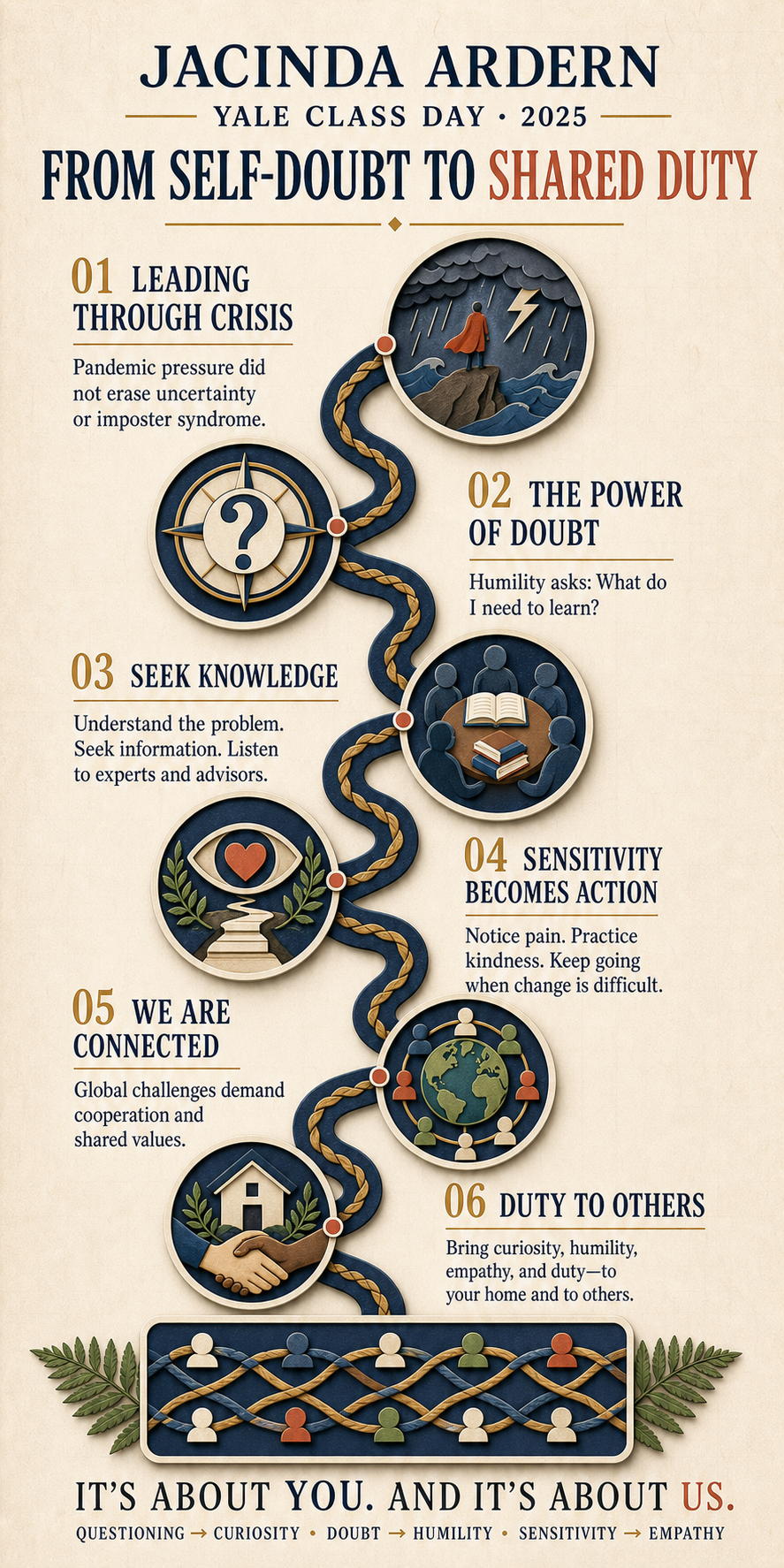
Jacinda Ardern at Yale, 2025
A Class Day address about self-doubt as strength, sensitive leadership, humility, connection, and duty in an interdependent world.
Speech arc
- 01Imposter syndrome
Opening move
- 02Pandemic pressure
Speech beat
- 03Self-doubt
Speech beat
- 04Sensitivity
Speech beat
- 05Humility
Speech beat
- 06Expertise
Speech beat
- 07Connection
Speech beat
- 08Not just you
Final charge
Confession: Doubt can sharpen leadership
Ardern uses her own experience of imposter syndrome under pandemic pressure to recast doubt as a check against arrogance.
Pressure
The pandemic story grounds leadership advice in a moment when decisions carried public consequence.
Doubt
Questioning oneself becomes a reason to seek evidence and listen harder.
Strength
The trait that feels like weakness can keep power open to correction.
Ardern uses her own experience of imposter syndrome under pandemic pressure to recast doubt as a check against arrogance.
Sensitivity: Empathy belongs in the room
The address argues that sensitivity and emotional awareness are not liabilities but tools for understanding people and consequences.
People
Good decisions start by noticing who will feel their effects.
Curiosity
Sensitivity leads to better questions because it refuses to flatten experience.
Courage
Empathy requires stamina when the easier pose is distance.
The address argues that sensitivity and emotional awareness are not liabilities but tools for understanding people and consequences.
Humility: Complex problems require shared knowledge
Ardern connects humility to expertise, cooperation, and the recognition that no leader sees enough alone.
Experts
Seeking expertise is framed as competent leadership, not abdication.
Limits
Knowing what you do not know protects decisions from ego.
Team
Shared values turn specialized knowledge into collective action.
Ardern connects humility to expertise, cooperation, and the recognition that no leader sees enough alone.
• Key takeaways •
Doubt checks ego
Connects to leadership.
Sensitivity is intelligence
Connects to empathy.
Humility seeks expertise
Connects to humility.
Connection changes duty
Connects to connection.
Leadership serves us
Connects to service.
Closing charge
The closing charge moves from personal achievement to interdependence, asking graduates to define success through duty to others.
The world asks for an us
Interdependence
Global challenges cross borders, disciplines, and private ambitions.
Duty
Graduates are asked to use influence for more than individual ascent.
Us
The memorable turn is from self to shared responsibility: not only you, but us.
The closing charge moves from personal achievement to interdependence, asking graduates to define success through duty to others.
Visual speech maps
Browse more visual maps from Yale University or continue with related mapped speeches below.
Transcript
No official full transcript has been located yet. If you know of one, suggestions are welcome.
Provenance
Verified from official archive; targeted event-level link verified
Category: Service/Activism
Explore this speech
Find the next thread through the archive
Themes in this address
Speeches like this one
Search all speeches ->