Elizabeth Alexander
Poet, educator, and cultural advocate
In her 2023 Class Day address at Yale, poet Elizabeth Alexander returned to her alma mater to celebrate freedom, lifelong education, and homecoming, drawing on her experiences as a Yale undergraduate, faculty member, and parent. She recounted the 1831 proposal to establish the nation's first college for Black students in New Haven, which was overwhelmingly blocked, using it to question what those who ban education today fear. She urged graduates to keep learning, speak truth to power, bring new voices into rooms they enter, and work to make freedom real for everyone.
“What will you do to make the dream of freedom real for everyone?”
Key moments
- 01 Greeting graduates as a former undergraduate, faculty member, Yale mom, and New Havener
- 02 Recounting the 1831 proposal for a Black college in New Haven that was blocked 700 to 4
- 03 Questioning what those banning education today fear
- 04 Offering parental advice to keep learning, rest, speak truth to power, and take action
Save the visual map
Download or open the generated poster as a standalone PNG.
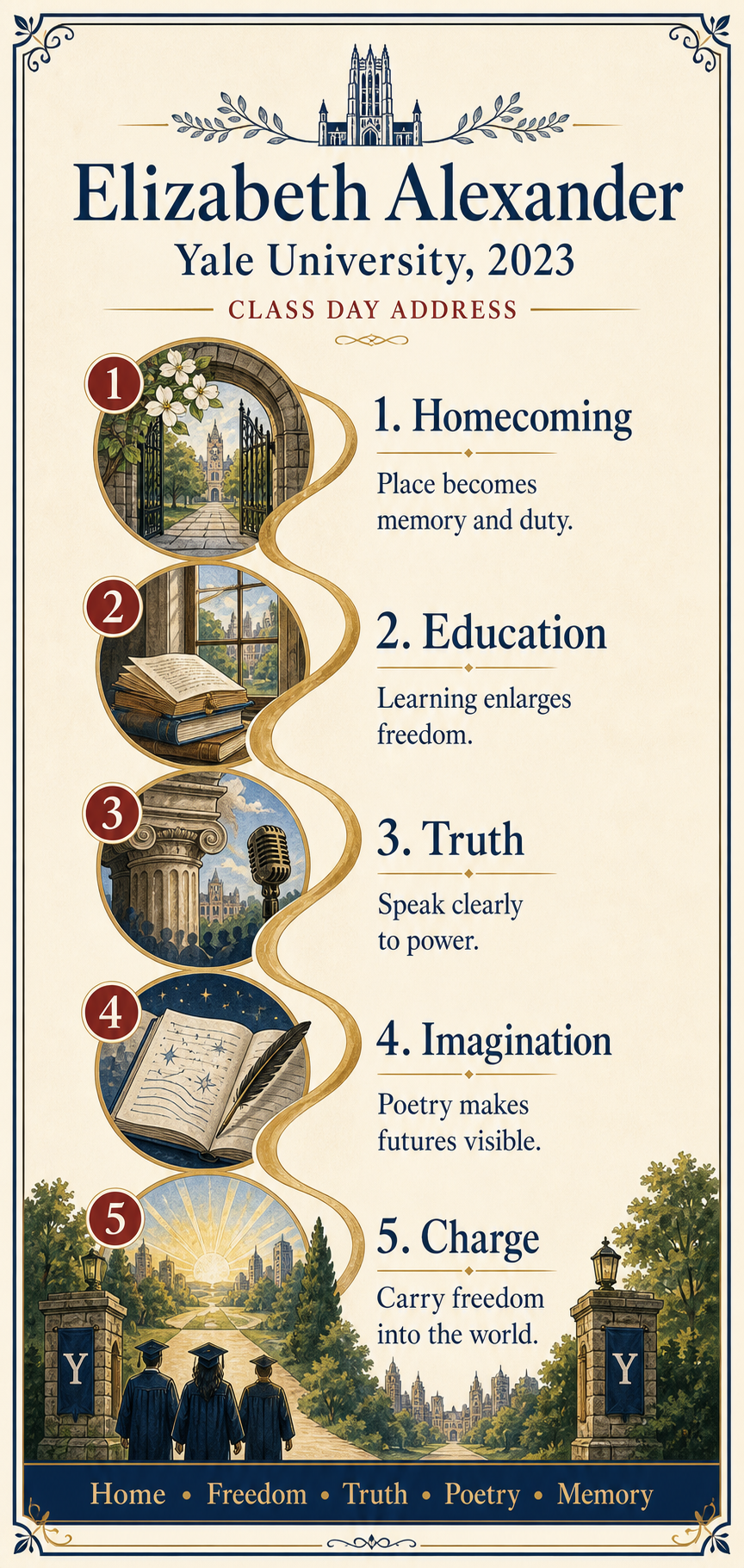
Elizabeth Alexander at Yale, 2023
A Class Day address about homecoming, education as freedom work, historical imagination, truth to power, and lifelong learning.
Speech arc
- 01Homecoming
Opening move
- 02New Haven
Speech beat
- 03Education
Speech beat
- 04Freedom
Speech beat
- 05Books
Speech beat
- 06Truth
Speech beat
- 07Empathy
Speech beat
- 08Dream work
Final charge
Return: Home is a layered classroom
Alexander returns as alumna, former faculty member, Yale parent, and New Havener, turning place into a source of obligation and memory.
Roles
Multiple Yale identities give the address a long view of belonging and responsibility.
City
New Haven is treated as more than backdrop; it is part of the education.
Memory
Homecoming gives the speech emotional authority without closing off critique.
Alexander returns as alumna, former faculty member, Yale parent, and New Havener, turning place into a source of obligation and memory.
Education: Learning enlarges freedom
The address links books, historical perspective, sharpened thinking, and imagination to the work of living freely with others.
Books
Reading becomes a democratic resource, not merely a private credential.
Perspective
Historical awareness helps graduates resist the narrowness of the present moment.
Empathy
Other worlds entered through art and study expand what responsibility can mean.
The address links books, historical perspective, sharpened thinking, and imagination to the work of living freely with others.
Voice: Truth must meet power
Alexander urges graduates to use cultivated imagination and knowledge in public, especially where speech can clarify injustice.
Courage
Education earns force when it is willing to speak beyond comfortable rooms.
Power
Privilege is measured by whether it opens freedom for others.
Art
Poetic imagination supplies language for realities that institutions often flatten.
Alexander urges graduates to use cultivated imagination and knowledge in public, especially where speech can clarify injustice.
• Key takeaways •
Home carries obligation
Connects to education.
Books widen freedom
Connects to freedom.
History sharpens judgment
Connects to homecoming.
Truth needs public voice
Connects to truth.
Dreams become work
Connects to imagination.
Closing charge
The closing logic is incremental and expansive: idea by idea, book by book, soul by soul, graduates can widen the circle of learning.
Carry freedom dream by dream
Practice
Freedom work is made through durable habits rather than one ceremonial moment.
Reach
What Yale offers should not stop at Yale's gates or with its graduates.
Dream
Imagination is treated as a public tool for making better futures thinkable.
The closing logic is incremental and expansive: idea by idea, book by book, soul by soul, graduates can widen the circle of learning.
Visual speech maps
Browse more visual maps from Yale University or continue with related mapped speeches below.
Transcript
No official full transcript has been located yet. If you know of one, suggestions are welcome.
Provenance
Verified from official archive; targeted event-level link verified
Category: Writing/Creative
Explore this speech
Find the next thread through the archive
Themes in this address
Speeches like this one
Search all speeches ->