Reshma Saujani
Advocate for women and girls
Reshma Saujani, a Yale Law graduate and founder of Girls Who Code, delivered Yale's 2022 Class Day address, urging graduates to value advocacy and the American tradition of agitating for change. She reframed President Kennedy's famous call to service, arguing that in an era of declining trust in government and rising inequality, graduates should first ask what they can do for themselves and prioritize self-healing. She concluded that the country needs them to take care of one another and reimagine a world that better supports everyone.
“Sometimes you're at your strongest when you withdraw. That you've got to go inward first before charging forward.”
Key moments
- 01 Praise for advocacy and fighting for women and girls
- 02 Reinterpreting JFK's 'ask not' quote for a low-trust era
- 03 Contrasting mid-century American achievements with present inequality and crises
- 04 Warning against 'hustle culture' and urging self-healing before serving others
Save the visual map
Download or open the generated poster as a standalone PNG.
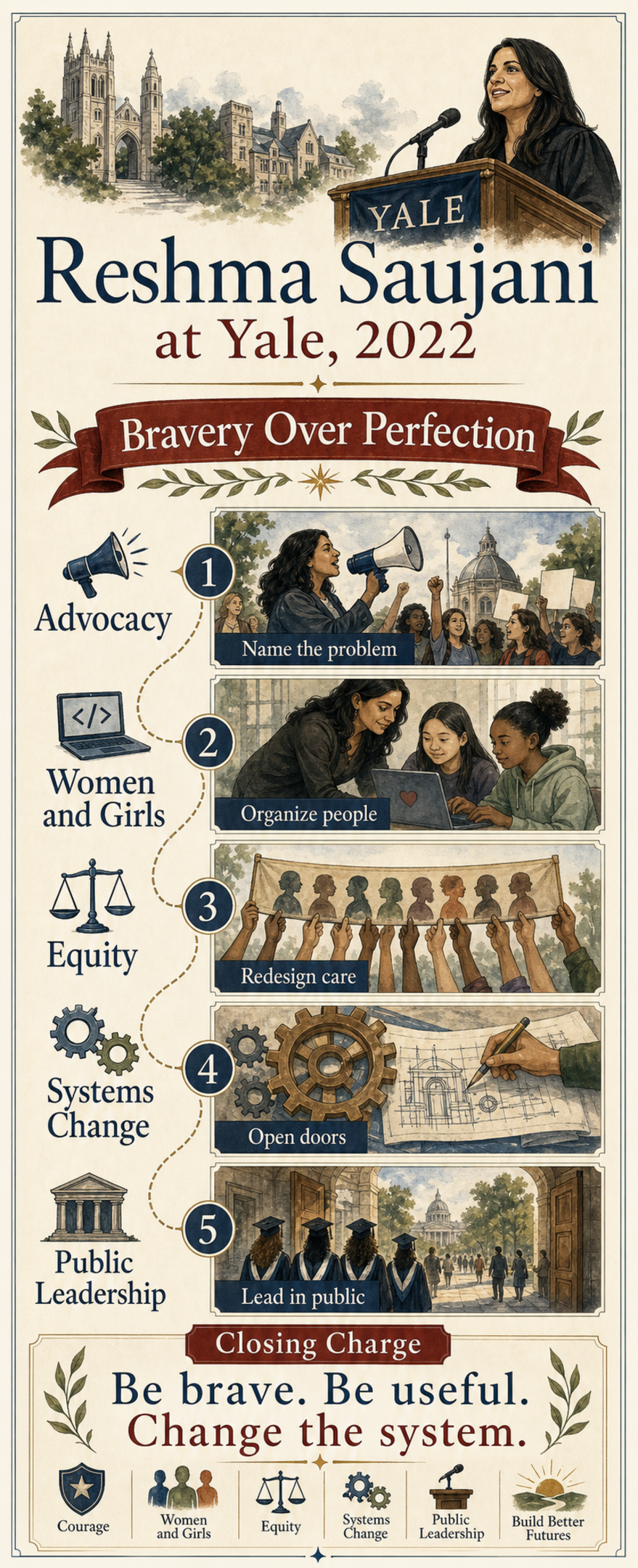
Reshma Saujani at Yale, 2022
A Class Day address about post-pandemic redesign, advocacy, women and girls, courage, and pushing institutions toward a more perfect union.
Speech arc
- 01Return to campus
Opening move
- 02Resilience
Speech beat
- 03Advocacy
Speech beat
- 04Girls Who Code
Speech beat
- 05Pay Up
Speech beat
- 06Women
Speech beat
- 07Agitation
Speech beat
- 08Redesign
Final charge
Return: The ceremony resumes in person
Saujani speaks at Yale's first fully in-person Class Day in three years, making resilience and institutional redesign part of the moment.
Setting
The Old Campus gathering marks a visible return after disrupted pandemic ceremonies.
Class
Graduates are recognized for resilience, bravery, and determination across unstable years.
Opening
The day carries celebration and a demand to rethink what comes next.
Saujani speaks at Yale's first fully in-person Class Day in three years, making resilience and institutional redesign part of the moment.
Advocacy: Change starts with agitation
The address casts fighting for people, especially women and girls, as patriotic work aimed at making systems more just.
Fight
Advocacy is framed as love in public: persistent, specific, and willing to push.
Union
The promise of a more perfect union requires people who insist things can be different.
Voice
Graduates are invited to use their standing to name structural failures clearly.
The address casts fighting for people, especially women and girls, as patriotic work aimed at making systems more just.
Systems: Redesign work after crisis
Saujani connects her Girls Who Code and Pay Up work to a larger post-pandemic chance to rebuild business, culture, and care.
Code
Girls Who Code stands for opening technical opportunity where it has been restricted.
Care
Pay Up widens the frame from individual ambition to economic structures around women.
Moment
Crisis creates a rare chance to question defaults that once seemed fixed.
Saujani connects her Girls Who Code and Pay Up work to a larger post-pandemic chance to rebuild business, culture, and care.
• Key takeaways •
Resilience should redesign
Connects to advocacy.
Advocacy is public love
Connects to women and girls.
Women need structural support
Connects to equity.
Agitation can be patriotic
Connects to courage.
Better futures are built
Connects to systems change.
Closing charge
The closing charge asks graduates to step into movements, challenge inherited designs, and build institutions that match their stated values.
Demand better futures
Courage
Bravery means asking for more than personal advancement from powerful systems.
Movement
Individual talent gains force when joined to organized demands and shared care.
Future
A better future is treated as designed, fought for, and collectively maintained.
The closing charge asks graduates to step into movements, challenge inherited designs, and build institutions that match their stated values.
Visual speech maps
Browse more visual maps from Yale University or continue with related mapped speeches below.
Transcript
No official full transcript has been located yet. A video of the address is available above.
Machine transcript available for archive analysis; it is unverified and may contain transcription errors.
Provenance
Verified from official archive; targeted event-level link verified
Category: Service/Activism
Explore this speech
Find the next thread through the archive
Themes in this address
Speeches like this one
Search all speeches ->